

Artificial intelligence in health coaching is no longer a distant concept—it's here, embedded in the tools your clients use, the platforms you market on, and the systems running your business behind the scenes. AI coaching tools are reshaping how health coaches operate, communicate, learn, and scale, and understanding this shift is quickly becoming a core professional competency.
As Program Director at the Institute for Integrative Nutrition (IIN) and a National Board-Certified Health & Wellness Coach (NBC-HWC), I've had a front-row seat to how AI in health coaching is impacting our field. I often hear directly from students, alumni, and practicing coaches navigating real questions like:
Is AI going to replace health coaches?
Do I have to use AI in my practice to stay relevant?
Where do I even begin?
The truth is that AI in health coaching is changing the landscape—but not in the way many fear. It is not a replacement for human-led, client-centered coaching. Instead, AI coaching tools are reshaping how coaches operate, communicate, learn, and scale. The coaches who thrive in 2026 and beyond will be AI-literate—not AI-dependent.
The Rise of AI in Health Coaching: What the Data Shows in 2026
AI adoption is accelerating across industries at a remarkable pace. According to McKinsey & Company’s 2024 State of AI report, 65% of organizations now regularly use generative AI in at least one business function—nearly double the adoption rate from the previous year.
Small businesses are moving just as quickly. A 2024 Salesforce trends report found that over 60% of small business owners are experimenting with AI to streamline operations and marketing. The very entrepreneurs building coaching practices are operating in an ecosystem where AI fluency is becoming standard, not optional.
The International Coaching Federation (ICF) identifies AI and digital coaching platforms as one of the top emerging disruptors shaping the coaching profession through 2030. This isn’t speculative. It’s a recognized inflection point for coaching as a field. Additionally, industry surveys show a growing percentage of health coaches incorporating digital tools into session preparation, reflection prompts, and between-session accountability support.
Taken together, these signals point to one reality: AI isn’t replacing coaching—but it is reshaping the environment in which coaches work. And this shift isn’t just happening inside coaching businesses. It’s unfolding quietly in your clients’ everyday lives.
Clients are already interacting with AI-driven wellness trackers, symptom checkers, habit apps, and chat interfaces before they ever step into a coaching session. They’re receiving sleep scores, stress ratings, readiness metrics, personalized meal suggestions, and productivity nudges—often before they’ve paused to ask how they actually feel.
For some, this creates empowerment. For others, confusion, comparison, or pressure to optimize every variable. By the time clients arrive for a coaching session, they may already be carrying AI-generated insights—and sometimes AI-generated anxiety.
This is where coaching becomes essential: not to compete with technology, but to ground data points in lived experience, interpret patterns through a lens of bio-individuality, and create space for reflection. The question is no longer whether AI belongs in the wellness space; it’s whether coaches are prepared to help clients navigate it with discernment, self-trust, and agency.
AI Literacy for Health Coaches: What It Is and Why It Matters in 2026
AI literacy for coaches is the ability to understand how artificial intelligence works at a practical level, recognize its capabilities and limitations, evaluate outputs critically, and use it ethically and effectively within scope of practice.
In AI in health coaching contexts, literacy means:
In many ways, AI literacy is becoming a professional competency alongside topics like motivational interviewing and behavior change theory. That’s why IIN has integrated AI literacy directly into its Health Coach Training Program curriculum. As AI health coaching tools become more visible in the marketplace, new coaches must be prepared for the conversations clients are already having.
Will AI Replace Health Coaches? What Coaches Need to Know
The short answer: No.
AI in health coaching can analyze data patterns and generate suggestions. It cannot hold presence. Health coaching depends on the core skills of:
- Deep listening
- Emotional attunement
- Contextual understanding
- Values exploration
- Accountability through relationship
AI coaching tools can generate insights. They cannot witness grief, hold silence, or co-create transformation.
In IIN’s Health Coach Training Program, we emphasize that information does not equal transformation. Transformation happens in relationships. The future of AI health coaching is not AI versus coaches. It’s AI-supported, human-led coaching.
How Health Coaches Can Use AI Tools in Their Practice (Without Losing Authenticity)
1. Skill Development & Continuing Education
AI can support your growth as a health coach by helping you:
- Role-play coaching scenarios
- Reflect on session transcripts (without storing client data in unsecured systems)
- Explore different behavior change frameworks
- Generate case study practice prompts
Practice Prompt:
“Act as a client struggling with consistency around movement. Respond realistically to my open-ended questions so I can practice motivational interviewing.”
This allows you to sharpen your skills between real sessions.
2. Supporting Clients with AI (Within Scope of Practice)
AI should never be used to provide medical advice or replace professional judgment. However, coaches can:
- Help clients reflect on insights from wearable or tracking data
- Generate journaling prompts aligned with client goals
- Create habit-tracking templates
- Brainstorm non-prescriptive lifestyle ideas collaboratively
In this framework, the coach remains the facilitator, and AI functions as a background tool.
3. Streamlining and Scaling Your Coaching Business
AI is already transforming coaching operations. Coaches are using AI to:
- Draft newsletters and social media posts
- Outline workshop content
- Generate client onboarding documents
- Create and manage organizational systems
- Analyze survey feedback
- Brainstorm brand and niche positioning
High-Value Business Prompt:
“Help me refine my health coaching niche. My ideal client is a mid-career woman navigating burnout and hormonal shifts. Suggest messaging pillars and content themes.”
This type of prompting doesn’t replace your voice—it accelerates clarity.
How to Use AI Coaching Tools While Staying Human-First
Technology should amplify your authenticity, not dilute it. These are my top five tips for how to integrate AI into your coaching business with integrity:
Ethical Considerations for Using AI Tools in Health Coaching
AI in health coaching raises professional questions around data privacy, bias in outputs, over-reliance on automated suggestions, and scope-of-practice boundaries. Coaches must remember that AI generates likely patterns, not authoritative answers. It cannot replace professional discernment. Those who understand both the power and limits of AI are best positioned to safeguard clients and uphold coaching integrity.
AI in Health Coaching: What’s Next for the Industry in 2026
Based on industry forecasts and what I’ve observed among IIN students and alumni, these are the key trends that I predict will shape health coaching in the next five years:
1. Hybrid Coaching Models
Coaches will blend live sessions with digital tools that support habit tracking, reflection, and accountability between sessions. This layered approach enhances continuity while keeping the relationship central.
2. Automation as a Growth Partner
Behind the scenes, automation will streamline scheduling, onboarding, content creation, analytics, and client communication workflows. As efficiencies become standard, coaches will focus more on deep client transformation.
3. Guiding Clients Through the Noise
Clients will arrive with data from wearables, wellness apps, and AI-generated insights, expecting interpretation and context. Coaches who help navigate this information thoughtfully, without overstepping scope, will stand out as trusted guides.
4. Greater Emphasis on Human Skills
As automation rises, emotional intelligence becomes a competitive advantage. Paradoxically, the more advanced AI becomes, the more valuable human connection will become.
Why IIN Is Integrating AI Literacy into its Health Coach Certification Program
In developing IIN’s 2026 curriculum updates, we asked: What conversations are clients having today? What developments are shaping tomorrow? And what competencies will position Integrative Nutrition Health Coaches to lead? AI literacy topped that list.
This is about professional preparedness and not about chasing trends. We want coaches to feel competent and confident using AI in ways that enhance their practice while staying authentic.
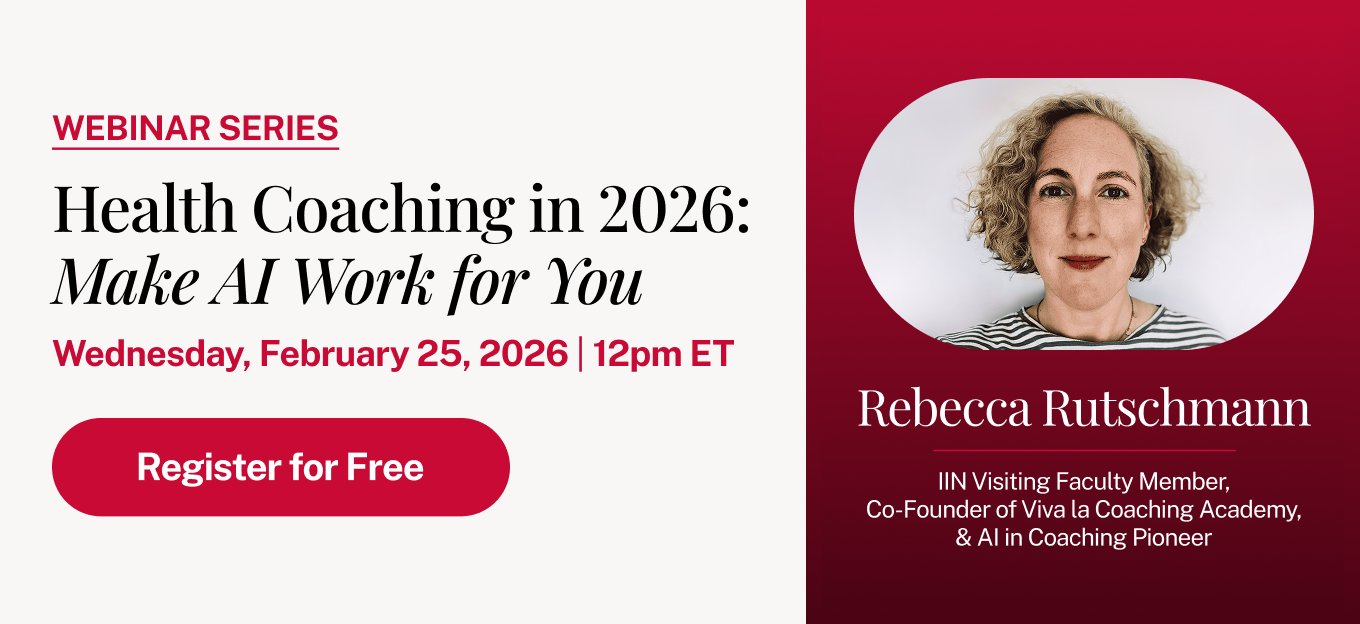
Rebecca Rutschmann, a pioneer in AI literacy for coaches, has contributed a new lecture to The Health Coach Training Program with practical frameworks, ethical guardrails, and actionable strategies.
On February 25th she’ll dive deeper in a free live webinar, sharing real-world use cases, demonstrations, and future industry insights beyond what this article covers.
Unlock AI Insights for Your Coaching Practice
If this topic feels expansive, nuanced, or slightly overwhelming, you’re not alone.
On February 25, 2026, new Visiting Faculty member Rebecca Rutschmann will lead a free live webinar for the IIN community exploring real-world use cases, ethical AI frameworks for coaches, and tips for staying competitive without compromising coaching integrity. You’ll leave with tangible next steps—whether you’re skeptical, curious, or already experimenting with AI.
Conclusion
AI is not the end of health coaching; it’s a turning point. The coaches who lead the next era aren’t those who resist technology, nor those who adopt blindly. They are the ones who approach it with discernment, literacy, and unwavering commitment to human connection.
Every major shift in health and wellness has brought new tools, new language, and new questions. What has remained constant is this: transformation happens in relationship. It happens when someone feels seen, heard, and supported in a way that no algorithm can replicate.
Health coaching has always been about empowerment. AI, when used wisely, can support that mission—but it cannot replace it. The future of health coaching is human-first—and AI-informed. And that future is already unfolding.
Author Bio
Lindsay Goldberg is a National Board Certified Health and Wellness Coach (NBC-HWC) and a 2014 graduate of IIN’s Health Coach Training Program, with a background in Mental Health Counseling. As IIN’s Program Director, she leads the development of IIN’s curriculum and cultivates educational partnerships with accreditors, higher education institutions, and professional organizations to help alumni build credible, successful careers as Integrative Nutrition Health Coaches.
-1.png)
Published: February 19, 2026
Updated: April 24, 2026